A gentle thump, followed by a scrape, then quiet. I assumed someone had dropped something heavy. Ten minutes later, it happened again. Thud. Scrape. Pause. Curiosity took over. Upstairs, I found my neighbour Anne, 78, on her living room carpet, caught halfway between kneeling and standing, laughing as she steadied herself.
“I’m practising getting off the floor,” she said, slightly breathless, cheeks flushed. “My physio says if I lose this, I lose everything.” She wasn’t speed-walking or lifting weights. She wore a wool jumper, moving carefully between floor and standing, like a child relearning balance — except with a pension card and a bus pass.
That moment stayed with me. Because once you hear the idea that after 70, the movement that truly matters is getting down and back up again, the world looks different. And it raises an uneasy question: what if the real measure of healthspan isn’t steps or gym sessions, but whether we still feel safe trusting the floor?
When fitness quietly changes meaning
For most of life, fitness is judged by visible markers: pace, muscle tone, gym habits. After 70, those measures start to blur. I’ve met men who can hike miles yet hesitate stepping off a low curb. I’ve seen women who swim weekly panic at the thought of sitting cross-legged on the carpet with grandchildren.
It’s rarely discussed openly, but everyone notices. The way Grandad grips furniture just to sit. The way Mum avoids low seating. The way an aunt jokes, “Don’t make me sit on the floor — I’ll never get up,” while fear slips through the laughter. It’s not only joints failing; it’s confidence slowly draining away.
Somewhere around the seventh decade, fitness shifts from what you can push or endure to what you can recover from. A stumble on the pavement. A misjudged step in the kitchen. The gym still helps, walking still matters, but this is different. This is about getting yourself back to safety without needing rescuers.
The invisible ability almost no one trains
We train strength, stamina, even balance. But few people deliberately practise what geriatric physiotherapists call floor confidence: lowering down, rolling, kneeling, pushing, and standing up in different ways. It sounds basic until you realise how many adults freeze at the idea.
The harsh reality is that after 70, the greatest threat isn’t skipping workouts — it’s falling. Not the fall itself, but what follows. Can you roll, crawl, improvise, and push yourself up? Or do you lie still, cold seeping in, waiting to be found? That gap between falling and rising often separates independence from long-term care.
We’ve all felt it while watching an older relative lower themselves to the floor, breath held, every movement tense. The rug suddenly feels dangerous. The room becomes a hazard. And beneath it all is a quiet thought: one day, this could be me.
The simple pattern that predicts healthspan
Some doctors quietly use what’s known as the sit-to-rise test. You start standing, sit on the floor, then stand back up using as little support as possible. It’s imperfect, but in seconds it reveals how balance, strength, coordination, and confidence are ageing together.
In Brazil, researchers followed thousands of people using this test and found a striking pattern: those who struggled most tended to die earlier in the years that followed. Not because the test was magical, but because it reflected real life. If standing up from the floor is a battle, recovering after a bathroom slip will be too.
This movement matters because it isn’t one action — it’s a chain. Ankles flex, hips hinge, knees bend, the spine rotates, hands search for support, and the brain rapidly maps escape routes. The entire system is being asked, can we still organise ourselves under pressure?
Unglamorous, but deeply valuable
No one posts videos of “floor practice day.” A long walk looks wholesome. A gym selfie looks impressive. A 76-year-old rolling carefully on a mat just looks ordinary. Yet ordinary is what keeps people living independently.
I once shadowed a community physiotherapist on home visits. She met a man in his early 80s, a former PE teacher, who apologised for not being “fit” anymore. He proudly recalled squash tournaments — until she asked him to lie on the carpet and stand back up. His hands shook. His expression changed. He remembered falling in his garden and waiting hours to be found.
He could still walk into town and climb stairs. But that single pattern — down and back up — had disappeared. With it went a huge part of his sense of safety. That loss often goes unnoticed until it’s too late.
Why walking and the gym aren’t enough after 70
Walking is excellent. The gym can be too. But both share a blind spot: they’re upright, predictable, and controlled. Life isn’t. Later life especially brings wet tiles, uneven soil, dim lighting, and unexpected obstacles.
Many exercise classes for older adults avoid the floor entirely. Trainers worry people won’t get back up. Participants fear getting stuck. Slowly, the floor becomes forbidden territory.
The irony is painful. By avoiding the floor to stay safe, we ensure that when it inevitably arrives, the body has no idea how to respond. Muscles that haven’t knelt in years don’t suddenly cooperate during a fall.
The overlooked movements that protect independence
After 70, the movements that protect healthspan are subtle. Rotating without fear. Lowering smoothly. Moving from lying to rolling to kneeling to standing without panic flooding the system.

These patterns won’t sculpt calves or spike heart rate. They offer something quieter and more powerful: options. If you trip, you can soften the fall. If you land on the floor, your body recognises the situation and finds a way back up.
There’s a quiet dignity in knowing your body still works with you, even when gravity intervenes.
How floor confidence reshapes everyday life
Think of floor confidence as learning a second movement language. Standing and walking is one. Being on the floor is another. Children are fluent in both. Adults often forget the second — until ageing makes it essential.
I’ve seen the change when people relearn it. A 72-year-old woman in a small class practised sitting on a mat and standing with chair support. Afterward, she trembled — not from effort, but emotion. “I thought I’d never do that again,” she said. That single skill reopened everyday moments: playing with her granddaughter, reaching under the bed, cleaning low shelves.
This doesn’t require youth or intensity. It requires patience, support, and acceptance of clumsiness. The rewards are practical and profound: safer showers, easier toilets, less fear of falling, and the relief of managing daily life independently.
The confidence no one can fake
People with floor confidence move differently at home. Their steps are looser. Their hips stay mobile. There’s an unspoken backup plan. If something unexpected happens, panic doesn’t take over.
Family members notice too. One woman told me she stopped pushing her father to move house after watching him calmly lower himself to fix a cable, then stand back up unaided. Nothing dramatic. Just quiet competence. That kind of confidence delays life-altering decisions.
What this looks like in real life
No one follows a perfect daily routine. What works is consistency in small moments. Two minutes while the kettle boils. A few repetitions during TV ads. Tiny habits layered into the day.
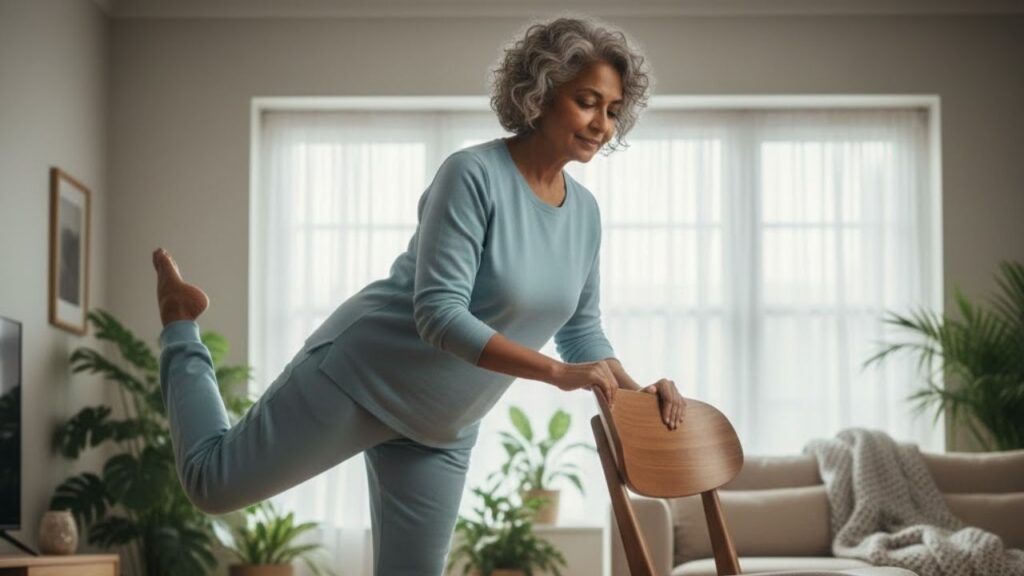
You might practise standing from a chair without using your hands. Another time, lower one knee onto a cushion, then the other, using furniture for balance. Another day, roll from your back to sitting, then kneeling, then standing with support.
You’re not chasing elegance. You’re reminding your body: we still know this. Some days will feel awkward. Others surprisingly easy. The victory is continuing to practise the one skill no one else can do for you.
Fear, pain, and giving yourself permission
Older bodies carry history — surgeries, arthritis, past falls. Fear of the floor is often rational. That’s why learning safely matters more than bravery. Physiotherapists would much rather guide you at home than see you injured later.
Pain changes the pattern, but doesn’t remove it. Higher surfaces, extra cushions, modified movements still teach the same skill. The pattern adapts to the person, not the other way around.
And if you’re far from 70, this still applies. Practising now is an investment. Every easy stand from the floor today is a deposit for a future moment when your body will need it.
Learning to trust the floor again
Anne jokes now that she’s “still negotiating with the carpet.” I’ve watched her progress from shaky, two-handed pushes to steadier stands. She complains constantly — but also says she feels less fragile in her own home. That’s a powerful outcome, even if it never appears on a poster.
We talk about lifespan and healthspan, but rarely describe what healthspan looks like on a quiet weekday when glasses slide under the sofa. After 70, it’s the difference between retrieving them yourself or waiting for help. One chips away at independence. The other protects it.
Walking and the gym still matter. They keep the engine running. But the movement that truly upgrades healthspan is humbler: your relationship with the floor. Your ability to go down, adapt, and rise again — under your own control, on your own terms.